

Creating content consistently does not guarantee that it will deliver results. Without proper assessment, it becomes difficult to know which content deserves more investment and which needs improvement. Therefore, understanding content performance gives marketers a way to connect content activity with measurable business outcomes.
What Does Content Performance Mean?
Content performance refers to how effectively a piece of content achieves the intended goals. Depending on the content type and marketing objective, those goals may include getting organic traffic, generating leads, increasing engagement, building brand awareness, or supporting conversions.
A successful piece of content is not necessarily the one with the highest number of views. Performance needs to be evaluated against the purpose for which the content was created. For example:
- A blog may be designed to generate organic search traffic
- A case study may be intended to support sales conversations
- A landing page may focus on generating leads
- A social post may aim to increase brand awareness
- A product guide may help move prospects closer to purchase
This is why marketers need to look beyond surface-level numbers when evaluating results.
Why Does Content Perform Good Matter?
Content requires time, expertise, research, and resources. Measuring results helps businesses assess whether those investments are producing desired outcomes or not. An effective measurement can reveal:
- Which topics attract the right audience
- Which channels generate valuable traffic
- Which pages keep visitors engaged
- Which content generates leads
- Which articles support conversions
- Where content needs improvement
- What subjects should be covered next
This information makes content planning more strategic. Instead of publishing based on assumptions, marketers can use evidence to decide what to create, update, promote, or retire.
What Are the Most Important Content Metrics?

The right content metrics depend on the content’s objective. There is no universal list of numbers that every business should monitor. Some of the important metrics include:
Traffic and Visibility
Organic sessions, page views, impressions, and search rankings can help determine whether content is being discovered. These metrics are particularly useful for SEO-driven content.
However, traffic does not always mean growth. A page attracting thousands of visitors who have no interest in the company’s products may generate less business value than a page attracting a smaller but highly relevant audience.
Engagement
Engagement metrics can help reveal whether visitors actually interact with the content. Some useful indicators include:
- Average engagement time
- Scroll depth
- Pages per session
- Returning visitors
- Video completion rates
- Social interactions
Engagement should always be interpreted within context. A short article answering a simple question may naturally have a shorter engagement time than a detailed industry guide.
Conversions
Conversions are among the most valuable content performance metrics because they connect content with an action that matters to the business. Depending on the organization, conversions may include:
- Form submissions
- Newsletter registrations
- Demo requests
- Downloads
- Purchases
- Consultation requests
- Account registrations
How to Track Performance Of Content?
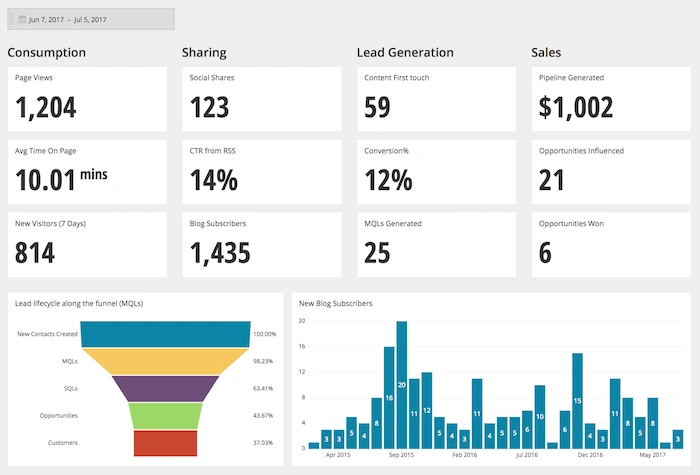
Knowing how to track content performance starts with defining what success means before publishing the content. A practical measurement process includes four stages:
1. Define the Objective
The first step is to decide what the content is supposed to accomplish. For example, the goal might be to generate 100 qualified organic visits per month or produce 10 consultation requests.
2. Select Relevant Metrics
The second step is to choose measurements that directly relate to that objective. If the goal is lead generation, conversion rate and qualified leads are more meaningful than social impressions alone.
3. Establish a Baseline
The third step must include comparing current performance with previous results. A baseline makes it easier to determine whether changes are actually leading to improvement.
4. Review Results Regularly
Lastly, performance should be evaluated over an appropriate period rather than based on isolated daily fluctuations.
Google Analytics can help marketers analyze traffic sources, user interactions, conversions, and other website activity, while Google Search Console provides search performance information such as clicks, impressions, and queries.
What Is Content Performance Analysis?
Content analysis involves examining content data to determine what is working, what is underperforming, and why. An analysis does not stop at identifying a high-performing article rather it focuses on what factors may have contributed to its success. For example, an analysis might reveal that:
- Long-form guides attract more organic traffic
- Comparison articles generate more leads
- Certain topics receive strong impressions but low click-through rates.
- Older pages lose traffic as competitors publish newer information
- Pages with stronger internal linking keep visitors moving through the website
What Is Content Marketing Performance Analytics?
Content marketing performance analytics combines content data with business objectives to understand the contribution of content marketing. Instead of asking only, “How much traffic did this article receive?” marketers can ask:
- Did this traffic come from the right audience?
- Did visitors engage with the website?
- Did the content contribute to leads or sales?
- Which content formats produce the strongest return?
These questions turn analytics into a decision-making tool rather than a collection of numbers.
How to Improve Performance Of Content?
- Update Outdated Information
- Strengthen Search Intent Alignment
- Improve Content Structure
- Strengthen Internal Linking
- Improve Calls to Action
- Repurpose Successful Content
Content Performance Tracking: What Should You Monitor Regularly?
Performance tracking works best when businesses establish a consistent reporting process. A monthly or quarterly review can categorize content into groups such as:
Top performers: Content generating strong traffic, engagement, leads, or revenue.
Growth opportunities: Content showing potential but requiring optimization.
Declining content: Previously successful pages that are losing visibility or engagement.
Underperforming content: Pages receiving little relevant traffic or producing minimal value.
This categorization makes content management more feasible.
Common Mistakes When Measuring Content
One of the biggest mistakes is focusing on metrics only. High page views may look impressive, but they do not necessarily indicate business success. Similarly, social engagement can provide useful audience signals without directly translating into revenue. Other common mistakes include:
- Measuring every metric without a clear objective
- Comparing different content types using identical benchmarks
- Ignoring assisted conversions
- Reviewing data over periods that are too short
- Failing to update older content
- Measuring traffic without considering traffic quality
Good measurement is not about collecting more data. It is about identifying the data that can support better decisions.
Final Verdict
Content performance provides a practical way to determine whether content is achieving its intended purpose. By combining traffic, engagement, conversion, search, and business metrics, marketers can understand which content creates genuine value and where improvements are needed.
For businesses looking to build a content strategy around measurable outcomes, Johnny’s Digital can help with content planning, SEO, performance analysis, and optimization designed to turn content investment into sustainable digital growth.
Frequently Asked Questions
1. How long should you wait before evaluating content performance?
The appropriate timeframe depends on the content type, distribution channel, and objective. SEO content may require several weeks or months to establish search visibility, while paid or social content can produce useful performance data much sooner.
2. Can old content still perform well?
Yes. Evergreen content can continue attracting traffic and conversions for years when it remains accurate, relevant, and competitive. Regularly reviewing older pages can reveal opportunities to update information, improve search intent alignment, strengthen internal links, and refresh calls to action.
3. What should you do if content gets traffic but no conversions?
First, examine whether the visitors match your target audience. If the traffic is relevant, review the content’s CTA, offer, landing-page experience, conversion path, and alignment with the reader’s buying stage. High traffic with low conversions can indicate an issue beyond the content itself.
4. Should every piece of content have the same performance target?
No. Different formats and topics serve different purposes. A blog designed for awareness may prioritize organic visibility and engagement, while a product comparison page may be expected to generate leads or sales.