

When people search for a business online, they often include a location or use terms that indicate local intent. Someone looking for a dentist may search for “dentist in Hawaii,” while another person might simply search for “dentist near me.” Understanding these searches is an important part of local SEO. Local SEO keyword research helps businesses identify the terms potential customers use when searching for products or services in specific areas.
It allows you to optimize your website, location pages, Google Business Profile, and local content around searches that have genuine business value.
What Is Local SEO Keyword Research?

Local SEO keyword research is the process of finding and analyzing search terms that people use to find businesses, products, or services within a specific geographic area. These terms can include:
- Service + location
- Product + location
- Business + city
- Service + neighborhood
- “Near me” searches
- Location-specific questions
- Localized service terms
Related Article: How Can You Do Local SEO For Multiple Locations?
Why Is Local Keyword Research Important?
Finding the right local SEO keywords helps you understand what your potential customers are actually searching for. It can help you:
- Identify local search demand
- Optimize location pages
- Improve local website visibility
- Discover new content opportunities
- Target specific service areas
- Understand customer search intent
- Prioritize valuable keywords
Instead of guessing what people search for, keyword research provides data that can guide your SEO decisions.
Types of Local SEO Keywords
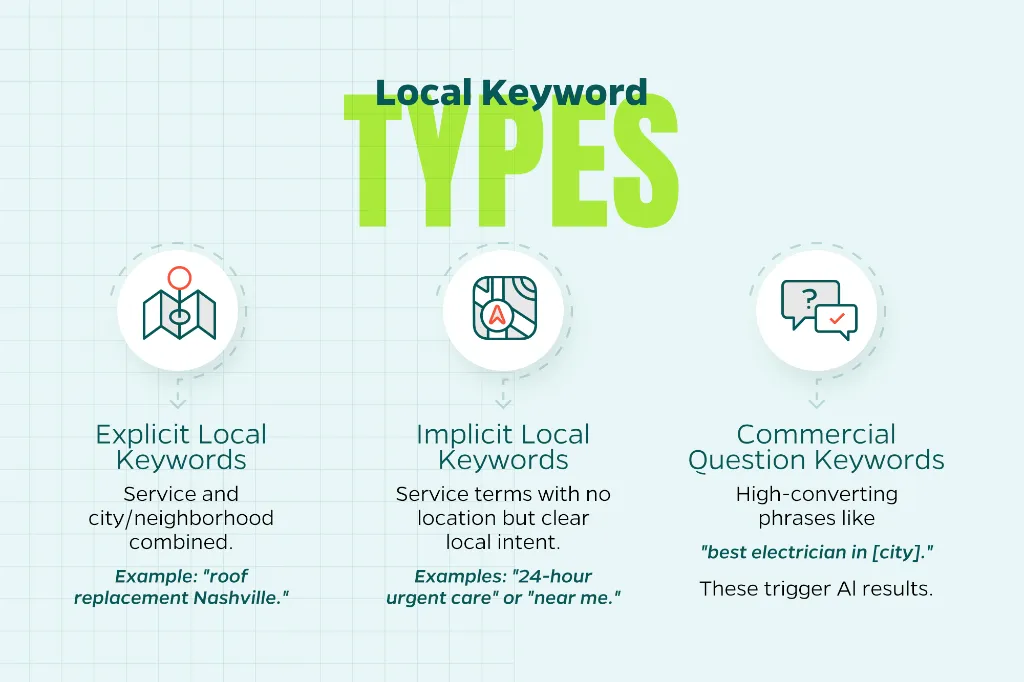
Before starting your research, understand the different types of keywords you may see such as:
Service-Based Keywords
These focus directly on what a business provides. For example:
- Plumbing services
- Dental clinic
- SEO services
- Car repair
Location-Based Keywords
These combine a service with a specific location. For example:
- Plumber in Hawaii
- Dentist in California
- SEO agency Missouri
Neighborhood Keywords
These target smaller geographic areas. For example:
- Dentist in Houston, Texas
- Cafe in New York
- Accountant near Boston
“Near Me” Keywords
Searches such as:
- “dentist near me”
- “restaurant near me”
- “SEO agency near me”
are known as near me keywords SEO searches.
Users do not need to type “near me” for Google to understand local intent. Search engines can use location signals and context to provide locally relevant results.
Local Question Keywords
These are informational searches with a geographic element. For example:
- How much does a wedding photographer cost in Washington?
- What is the best time to visit a dentist in Manhattan?
- Where can I get car detailing in Virginia?
These can provide useful content opportunities for local businesses.
Step-by-Step Local SEO Keyword Research

Step 1: Identify Your Core Services
Start by listing the products or services your business actually offers. For example, a digital marketing agency might offer:
- SEO services
- PPC advertising
- Social media marketing
- Content marketing
- Web design
Step 2: Add Your Target Locations
Next, combine your core services with the areas you serve.
For example:
SEO + Hawaii
SEO + Texas
SEO + California
This creates initial location-based keyword combinations. However, do not assume that every possible combination is worth targeting. The next steps help determine which searches have real value.
Step 3: Find Local Keywords
Use keyword research tools to discover related searches. Look for variations such as:
- Service + city
- Service + area
- Best + service + city
- Service + near me
- Service + neighborhood
- Service provider + city
For example, researching “SEO services Hawaii” might reveal related terms such as “SEO company Hawaii,” “SEO agency Hawaii,” and “SEO expert Hawaii.”
This gives you a broad understanding of how people search for the same service.
Step 4: Analyze Search Intent
Not every keyword has the same intent, so you should compare: “What is SEO?” with “SEO agency Hawaii”. The first is informational. The second has stronger commercial and local intent.
For local businesses, prioritize keywords that align with your business objectives. Common local search intents include:
- Informational
- Commercial
- Transactional
- Navigational
Understanding intent helps you decide whether a keyword belongs on a service page, location page, blog post, or business profile.
Step 5: Check Keyword Search Volume by City
One of the most useful parts of localized keyword research is understanding search demand in different areas. Keyword search volume by city can help you compare the potential demand between locations.
Step 6: Research Your Competitors
Search your priority keywords and examine the businesses appearing in local results. Look at:
- Which businesses rank
- What services they emphasize
- Their location pages
- Page titles
- Content structure
- Google Business Profiles
- Reviews
- Local backlinks
The goal is not to copy competitors. Instead, identify gaps that your business can address better.
Step 7: Find Neighborhood-Level Keywords
Some businesses can benefit from targeting smaller geographic areas.
For example, instead of targeting only: “SEO agency California” you may also find searches around:
- Fisherman’s wharf
- Old Town San Diego etc.
This type of keyword search based on locations can be valuable when customers commonly search by neighborhood. However, only target areas that are genuinely relevant to the business.
Step 8: Identify New Location Keywords
When a business expands, new location keyword research should be conducted before launching the new location page. So, you should research:
- City-level keywords
- Neighborhood searches
- Local service terms
- Competitors
- Related questions
- Local modifiers
Tools for Local SEO Keyword Research
Several tools can help with keyword research for local SEO including:
- Google Keyword Planner
- Google Search Console
- Google Search
- Google Maps
- SEO Platforms
Where to Use Local SEO Keywords
- Website Pages
- Location Pages
- Blog Content
- Google Business Profile
- Internal Links
Common Local Keyword Research Mistakes
- Targeting Every Location
- Ignoring Search Intent
- Focusing Only on Search Volume
- Keyword Stuffing
- Creating Duplicate Location Pages
- Ignoring Local Search Behavior
Final Words
Local SEO keyword research helps businesses understand how customers search for products and services in specific locations.
The process starts with identifying your services and target areas, followed by finding local keywords, analyzing search intent, checking search demand, researching competitors, and mapping keywords to relevant pages.
For businesses operating in multiple locations, keyword research should be performed for each market rather than simply duplicating the same strategy.
The goal is to target searches that are relevant to your business, valuable to your customers, and realistic for your website to compete for. When combined with useful content and a strong local SEO strategy, keyword research can provide a clear foundation for improving local search visibility.
FAQs
1. How many local keywords should a business target per page?
Focus on one primary local keyword and a few closely related terms that match the same search intent.
2. Is local keyword research different for every city?
Yes. Search demand, competition, terminology, and customer behavior can vary between cities, so research should be location-specific.
3. Can I use the same keyword for multiple locations?
Yes, when the service is genuinely offered in each location, but create relevant and useful content for each specific area.
4. Should I target keywords with low local search volume?
Yes. Low-volume local keywords can still attract valuable customers when they have strong commercial or transactional intent.