

Marketers track clicks, leads, conversions, revenue, customer acquisition costs, and return on advertising spend to understand whether campaigns are working. However, modern campaigns generate more data and require faster decisions than marketing teams can realistically make manually. This is where AI performance marketing is changing the way businesses plan, launch, optimize, and measure campaigns.
What Is AI Performance Marketing?
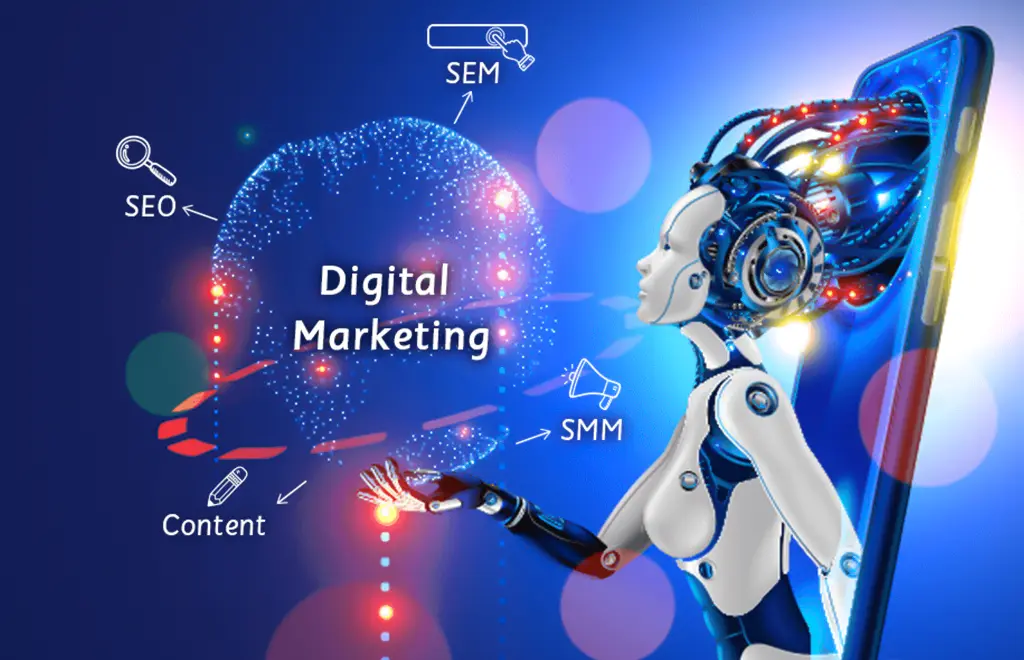
AI performance marketing is the use of artificial intelligence, machine learning, predictive analytics, automation, and generative AI to improve marketing outcomes.
Traditional performance marketing relies on predefined audiences, manual campaign optimization, human analysis, and rules-based decision-making. On the other hand, AI allows systems to process data and make predictions or recommendations based on changing patterns.
For example, an AI-powered campaign can analyze previous customer behavior and identify which audience segments are more likely to convert. It can then help marketers allocate budget toward those segments while continuously evaluating campaign performance.
How Does Artificial Intelligence in Performance Marketing Work?
1. Audience Identification
AI analyzes customer data, website behavior, purchase history, demographics, engagement patterns, etc. to identify valuable audience segments.
Rather than targeting customers based only on broad demographic characteristics, marketers can use behavioral and predictive signals to understand who is most likely to make a purchase.
2. Predictive Customer Analysis
Machine learning models can identify patterns in historical data and estimate the likelihood of future actions. For example, AI may help identify users who are:
- More likely to purchase
- Likely to abandon a shopping cart
- Showing high engagement
- More responsive to specific offers
- At risk of becoming inactive
This can help marketers prioritize audiences and marketing activities.
3. Automated Campaign Optimization
Campaign performance can change throughout the day based on audience behavior, competition, creative performance, and other factors.
AI systems can evaluate these signals continuously and help optimize factors such as audience allocation, bidding, placements, and budget distribution. This makes performance marketing with AI more responsive.
4. AI-Powered Creative Generation
Creative production is another major application of AI. Generative AI can assist marketers in developing:
- Ad copy
- Headlines
- Visual concepts
- Video concepts
- Product descriptions
- Multiple creative variations
- Personalized messaging
AI creative for performance marketing is particularly useful when campaigns require many variations for testing.
Major Benefits of AI Marketing
Businesses can use AI to improve several areas of campaign performance including:
- Better Targeting
- Faster Optimization
- Improved Personalization
- Marketing Efficiency
- Better Budget Allocation
AI Tools for Performance Marketing
The AI ecosystem for performance marketing includes tools for advertising, analytics, content creation, automation, customer data, and campaign management. Common categories include:
- AI Tool Category
- Predictive analytics
- Ad optimization platforms
- Generative AI
- Marketing automation
- Customer data platforms
- Conversational AI
- Analytics platforms
Many advertising platforms now have built-in machine learning capabilities. Therefore, businesses should evaluate both standalone AI tools and the AI features already available within their existing marketing platforms.
AI Marketing Performance Metrics

Some of the most useful AI marketing performance metrics include:
- Return on Ad Spend (ROAS): ROAS measures revenue generated relative to advertising expenditure. ROAS = Revenue from Ads ÷ Advertising Cost: It helps determine whether paid campaigns are generating sufficient revenue.
- Customer Acquisition Cost (CAC): CAC measures the average cost required to acquire a customer. CAC = Total Acquisition Cost ÷ Number of New Customers. AI can help marketers identify patterns that contribute to lower acquisition costs.
- Conversion Rate: Conversion rate measures the percentage of users who complete a desired action. Conversion Rate = Conversions ÷ Total Visitors or Clicks × 100.
- Cost Per Acquisition (CPA): CPA shows how much a business spends to generate a specific conversion or acquisition.
- Customer Lifetime Value (CLV): CLV estimates the value a customer can generate throughout their relationship with a business.
The Role of AI in Marketing Performance Analysis
One of the most valuable applications of AI is turning large volumes of marketing data into actionable insights.
The role of AI in marketing performance analysis can include identifying unusual performance changes, highlighting relationships between different campaign variables, forecasting results, and highlighting potential optimization opportunities.
For example, instead of simply reporting that conversion rates decreased, an AI system may help marketers investigate whether the decline is associated with a specific audience, creative, landing page, device type, or traffic source.
This shifts marketing analysis from simply answering “What happened?” toward asking “Why did it happen, and what should we do next?”
Challenges of Performance Marketing AI
Despite its advantages, performance marketing AI also has limitations.
Data Quality
AI depends on the quality of the data it receives. Incomplete, outdated, duplicated, or poorly structured data can produce unreliable recommendations.
Privacy and Compliance
For AI in performance marketing businesses must use customer data responsibly and comply with applicable privacy regulations.
Over-Automation
Giving AI complete control over marketing decisions can create risks. Human oversight remains important for brand safety, messaging, budget decisions, and strategic direction.
Creative Quality
AI-generated content can become repetitive or disconnected from a brand’s identity if it is produced without the right creative direction.
How to Implement AI in Performance Marketing
Businesses do not need to transform their entire marketing operation overnight. A phased approach is usually more practical.
- Step 1: Define Business Goals
- Step 2: Audit Your Data
- Step 3: Identify High-Impact AI Use Cases
- Step 4: Test and Compare
- Step 5: Keep Human Oversight
- Step 6: Scale What Works
What Is the Future of AI Marketing?

AI is moving performance marketing toward increasingly predictive and automated decision-making.
Instead of relying on historical reporting, marketers can increasingly use AI to forecast customer behavior, generate creative variations, personalize experiences, and identify optimization opportunities before performance problems become significant.
At the same time, human expertise will remain essential. Strategy, brand positioning, customer understanding, ethical decision-making, and creative judgment cannot simply be reduced to automated outputs.
The great marketing teams will likely be those that combine AI capabilities with human expertise rather than treating the two different approaches.
Final Words
AI marketing combines artificial intelligence with measurable, results-focused marketing to improve targeting, optimization, creative production, personalization, analysis, and decision-making.
From predictive audience analysis to AI tools for performance marketing, automated optimization, creative generation, and smarter performance measurement, AI can help businesses make faster and informed marketing decisions.
However, successful implementation requires more than adopting AI tools. Businesses need reliable data, clear KPIs, appropriate measurement frameworks, human oversight, and a strategy that connects AI activity to real business outcomes.
Frequently Asked Questions
1. What is AI marketing?
AI performance marketing is the use of artificial intelligence, machine learning, automation, and predictive analytics to improve measurable marketing outcomes such as conversions, ROAS, customer acquisition costs, and revenue.
2. How is AI used in performance marketing?
AI can be used for audience segmentation, predictive analysis, campaign optimization, bidding, personalization, creative generation, automated reporting, and performance forecasting.
3. Can AI replace performance marketers?
No. AI can automate repetitive processes and analyze large amounts of data, but marketers still need to provide strategy, creative direction, brand judgment, customer understanding, and oversight.
4. What is AI creative for performance marketing?
AI creative refers to using generative AI to assist with producing and testing advertising copy, images, videos, headlines, concepts, and other creative variations designed to improve campaign performance.