

Choosing the right ecommerce platform is one of the most important decisions when building an online store. Your platform affects how easily you can manage products, optimize pages, improve website performance, and control important SEO elements. But which are the best ecommerce platforms for SEO? There is no single answer for every business. The right choice depends on your store size, technical skills, product , budget, and how much control you need over your website.
What Makes an Ecommerce Platform Good for SEO?
Before comparison, understand what actually matters for the best ecommerce platforms for SEO. A good platform should provide:
- Editable title tags and meta descriptions
- Clean and manageable URLs
- XML sitemaps
- Mobile-friendly pages
- Fast hosting and performance
- Canonical controls
- Redirect management
- Structured data support
- Good site architecture
- Content management capabilities
- Integration with SEO tools
However, having these features does not automatically make a store rank. Product quality, content, backlinks, technical optimization, user experience, and overall SEO execution still matter. However, current 2026 comparisons emphasize that the platform is an SEO foundation, not a substitute for good optimization.
Related Article: SEO Strategy For Ecommerce Website: A Complete Guide
10 Best Platforms for Ecommerce SEO
1. Shopify

Shopify is one of the strongest all-around options for businesses that want an easy-to-manage seo ecommerce platform. It handles many technical elements automatically, including XML sitemaps, canonical tags, SSL, and mobile-responsive themes. Merchants can also edit important SEO elements on products, collections, pages, and blog posts. Its large app ecosystem provides additional options for advanced SEO requirements.
Pros
- Easy to manage
- Strong technical foundation
- Fast hosted infrastructure
- Large app ecosystem
- Good scalability
Cons
- Less URL flexibility than some open-source platforms
- Advanced customization may require apps or development
2. WooCommerce
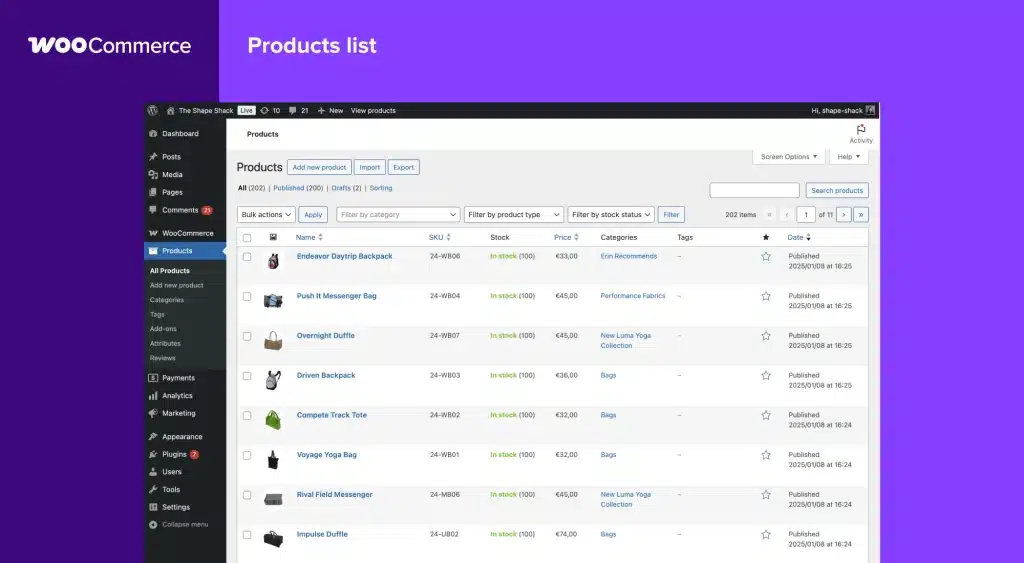
WooCommerce works with WordPress and gives merchants extensive control over website content and technical SEO. Because it operates within WordPress, businesses can use a wide range of SEO plugins and tools to manage metadata, schema, redirects, XML sitemaps, content, and other SEO elements.
Pros
- Highly customizable
- Excellent content capabilities
- Extensive SEO plugin ecosystem
- Full control over website infrastructure
Cons
- Requires more technical management
- Plugin conflicts can create problems
- Performance depends heavily on hosting and configuration
3. BigCommerce

BigCommerce is a strong search engine friendly ecommerce platform designed for businesses that need advanced ecommerce functionality without managing their own hosting infrastructure.
It provides built-in SEO capabilities, including editable metadata, SEO-friendly URLs, redirects, and structured data support.
Pros
- Strong built-in SEO features
- Good scalability
- Suitable for large product catalogs
- Strong multi-channel capabilities
Cons
- Can be more complex for beginners
- Some advanced features may require higher-tier plans
4. Wix

Wix has become a practical option for businesses that want ecommerce functionality without complicated technical management. It provides control over important SEO elements such as page titles, meta descriptions, URLs, structured data, and redirects.
Current 2026 platform comparisons specifically identify Wix as a strong option for smaller businesses that prioritize SEO and design flexibility.
Pros
- Easy to use
- Strong design flexibility
- Built-in SEO tools
- Suitable for smaller stores
Cons
- Less suitable for highly complex ecommerce operations
- Advanced customization can be more limited than open-source platforms
5. Adobe Commerce
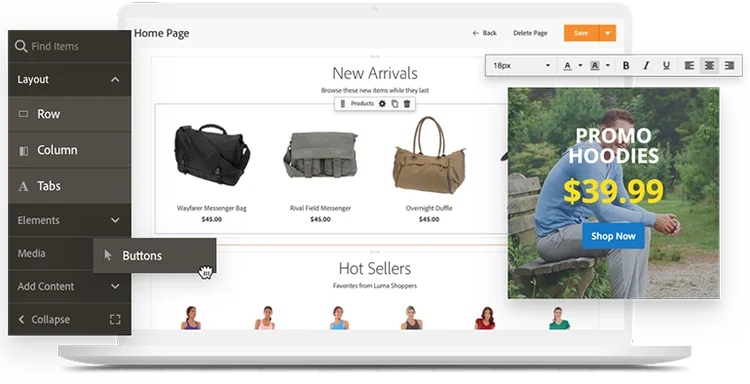
Adobe Commerce, formerly associated with Magento, is designed for businesses that need extensive customization and advanced ecommerce functionality. Its flexibility allows experienced development teams to control complex website structures, product catalogs, international stores, and technical SEO requirements.
Pros
- Highly customizable
- Excellent for large catalogs
- Strong enterprise capabilities
- Advanced technical control
Cons
- Expensive compared with simpler platforms
- Requires technical expertise
- More complex to maintain
6. PrestaShop

PrestaShop provides considerable control over ecommerce websites and can support important SEO functions through its core features and available modules. Its open-source structure allows businesses to customize their stores extensively.
However, businesses may need technical knowledge to maintain performance, security, modules, and SEO functionality.
Pros
- Open source
- Flexible customization
- Suitable for international stores
- Large ecommerce feature set
Cons
- Requires technical management
- Modules can increase complexity
- Hosting and maintenance are your responsibility
7. Squarespace

Squarespace is particularly appealing to businesses where branding and visual presentation are important. It provides basic SEO functionality, including editable page titles, descriptions, URLs, and other optimization options.
Its simplicity makes it preferred for smaller product catalogs, although businesses with highly complex SEO requirements may eventually need a more flexible platform.
Pros
- Excellent design
- Easy to manage
- Built-in hosting
- Suitable for smaller catalogs
Cons
- Less technical flexibility
- Not ideal for highly complex ecommerce websites
8. Shopware

Shopware is a good ecommerce platform with strong customization capabilities and support for larger online stores. Its flexibility allows businesses to build structured ecommerce experiences and manage important SEO elements.
It can be suitable for businesses operating in markets where localization, multiple storefronts, and complex catalogs are important.
Pros
- Flexible architecture
- Strong ecommerce capabilities
- Suitable for larger businesses
- Good customization options
Cons
- Requires more technical knowledge
- May be excessive for very small stores
9. OpenCart

OpenCart is an open-source ecommerce platform that allows businesses to create and customize online stores. It provides control over important ecommerce and SEO elements, while extensions can add further functionality.
As with other open-source platforms, however, website owners are responsible for hosting, maintenance, security, and optimization.
Pros
- Open source
- Customizable
- Large extension ecosystem
- Suitable for smaller and medium-sized stores
Cons
- Requires technical maintenance
- SEO performance depends heavily on configuration
10. Ecwid

Ecwid is useful for businesses that already have a website and want to add ecommerce functionality without rebuilding their entire online presence. It can work well for smaller catalogs and businesses that want a relatively simple setup. Its main advantage is convenience rather than extensive technical control.
Pros
- Easy to integrate
- Simple setup
- Suitable for smaller businesses
- Can be added to existing websites
Cons
- Less control than open-source platforms
- Not ideal for highly complex ecommerce SEO
Which Are The Best Ecommerce Platforms For SEO?
For most businesses, Shopify is a strong overall choice because it combines technical SEO capabilities, performance, scalability, and ease of management.
WooCommerce can be the better choice if maximum control over content and technical SEO is the priority.
BigCommerce is a strong option for larger catalogs and growing businesses.
Wix works well for smaller businesses that want SEO functionality without extensive technical work.
For enterprise businesses, Adobe Commerce or Shopware may provide the level of customization required.
There is no universal winner. The best platform is the one that gives your team enough control to build, optimize, and maintain the store effectively.
How to Choose an SEO-Friendly Ecommerce Platform
Before choosing a platform, ask these questions:
- Can I edit important SEO elements?
- Can the platform handle my catalog?
- Is the website fast?
- Can I create useful content?
- Can I scale it in future?
Does Your Ecommerce Platform Determine SEO Success?
No, a technically strong platform cannot compensate for poorly executed SEO. A store can still struggle to rank because of:
- Thin product descriptions
- Poor category structure
- Duplicate content
- Weak internal linking
- Slow pages
- Poor keyword targeting
- Weak backlinks
- Poor user experience
- Poor product and category optimization
The platform provides the foundation but your SEO strategy determines how effectively you use it.
Final Words
The best ecommerce platforms for SEO depends on your business requirements, technical resources, catalog size, and growth plans. Shopify is a strong overall choice for most businesses, while WooCommerce offers greater control for teams that want to manage their own WordPress environment. BigCommerce is well suited to growing stores, Wix works well for smaller businesses, and Adobe Commerce or Shopware can support more complex enterprise requirements.
Before choosing a platform, look beyond marketing claims. Evaluate its control over URLs, metadata, structured data, site architecture, performance, content, and scalability.
FAQs
1. Does changing an ecommerce platform affect SEO?
Yes. A platform migration can affect SEO if URLs, redirects, metadata, internal links, or indexing settings are not handled correctly.
2. How often should ecommerce SEO settings be checked?
Check important SEO settings regularly, especially after website updates, theme changes, product additions, or platform changes.
3. Can a small ecommerce store rank well on any platform?
Yes. A small store can rank well if its platform supports SEO basics such as crawlable pages, fast loading, optimized content, and proper indexing.
4. What is the biggest SEO risk when moving an online store?
The biggest risk is losing existing search visibility because important URLs, redirects, content, or SEO settings are not transferred correctly.