
Search engine optimization has always evolved alongside search technology. Today, AI SEO services are becoming an important part of this SEO evolution. Instead of relying entirely on manual research and optimization, businesses can now use artificial intelligence to analyze search data, identify patterns, optimize websites, generate content insights, and explore opportunities.
The growth of AI-powered search also means traditional rankings are no longer the only consideration. Search engines and generative search systems attempt to understand the context, intent, authority, and usefulness of information before presenting it to users.
So, to understand what exactly are AI SEO services, and how they work, read below.
What Are AI SEO Services?

AI SEO services are search engine optimization services that use artificial intelligence, machine learning, natural language processing, automation, and data analysis to improve a website’s search visibility and organic performance.
A traditional SEO service may involve manually researching keywords, analyzing competitors, reviewing technical issues, optimizing pages, and monitoring rankings.
An AI SEO service can enhance many of these activities by processing large datasets and identifying patterns that would take longer for humans to uncover. AI can assist with:
- Keyword and search-intent research
- Topic and content gap analysis
- Competitor analysis
- Content optimization
- Internal linking recommendations
- Technical SEO analysis
- Search performance monitoring
- Content briefs
- Entity and semantic analysis
- SEO forecasting
- Website optimization
- Generative search visibility
How Do AI SEO Services Work?
1. Data Collection
AI systems begin by analyzing information from sources such as websites, search results, keyword databases, analytics platforms, and SEO tools. The system may assess:
- Search queries
- Existing rankings
- Competitor pages
- Backlinks
- Website structure
- Content performance
- User behavior
- Search intent
- Technical issues
2. Search Intent Analysis
AI can analyze search queries and categorize their likely intent, such as:
- Informational
- Navigational
- Commercial
- Transactional
For example, someone searching for “best CRM for small businesses” has a different intent from someone searching for “what is CRM software?” Therefore, understanding this difference helps businesses create pages that better fulfil the search need.
3. Keyword and Topic Discovery
AI can analyze thousands of related queries and identify connections between topics.
Instead of focusing exclusively on one keyword, businesses can build broad topical coverage around related entities, questions, subtopics, and concepts.
This supports AI search engine optimization by helping websites provide comprehensive information rather than solo keyword-targeted pages.
4. Content Analysis and Optimization
AI can compare existing content against search results and identify potential gaps. For example, an AI system may identify:
- Missing subtopics
- Weak explanations
- Unanswered questions
- Poor content structure
- Missing contextual relationships
- Opportunities for internal links
- Areas where competitors provide greater depth
The objective is not simply to increase keywords across pages. It is to make the content more useful and relevant to the user’s query.
5. Technical Website Optimization
AI website optimization can involve identifying technical problems that affect crawling, indexing, usability, and performance. AI-assisted analysis can help detect:
- Broken links
- Duplicate content
- Missing metadata
- Poor internal linking
- Crawlability issues
- Slow-loading pages
- Indexation problems
- Weak site architecture
AI in SEO: Major Use Cases
AI-Powered Keyword Research: AI in SEO can identify keyword relationships, search intent, emerging queries, and semantic variations.
Automated Content Briefs: AI can analyze ranking pages and produce briefs containing structure of headings, questions, entities, and content requirements.
Competitor Analysis: AI can process competitor websites at scale and highlight differences in content coverage, keyword targeting, site structure, backlink profile, topic authority and search visibility.
Internal Linking: AI can identify relationships between pages and recommend contextual internal links, helping users find relevant content and search engines to understand the relationships between pages on a website.
SEO Performance Analysis: Instead of manually reviewing hundreds of metrics, AI can summarize performance changes and identify unusual patterns.
What Is AI-Powered SEO?
AI-powered SEO refers to using artificial intelligence throughout multiple stages of the optimization process. A business might use AI to:
- Identify opportunities
- Analyze search intent
- Build content clusters
- Optimize existing pages
- Identify technical issues
- Recommend internal links
- Monitor performance
- Analyze competitors
- Predict potential trends
- Support strategic decision-making
A human SEO specialist may be able to manually review a limited number of pages in a working day. AI can analyze thousands of URLs or data points much faster, allowing specialists to spend more time interpreting findings and making strategic decisions.
AI Search Optimization Services and Generative Search
SEO is expanding beyond traditional blue-link search results. Today, users prefer AI-generated summaries and conversational search experiences that answer questions directly.
This creates demand for AI search optimization services focused on improving a brand’s visibility across emerging AI-powered environments.
The goal is to ensure businesses make their information easy to understand, trustworthy, well-structured, and supported by credible evidence.
What Is Generative Engine Optimization?
Generative Engine Optimization, often abbreviated as GEO, focuses on improving the likelihood that a brand or source is accurately represented within AI-generated search responses. This can involve:
- Clear factual information
- Strong topical authority
- Consistent brand information
- Structured content
- Relevant entities
- Credible sources
- Author expertise
- Strong digital reputation
Therefore, top solutions for AI visibility and generative engine optimization should combine traditional SEO bases.
AI Website Optimization
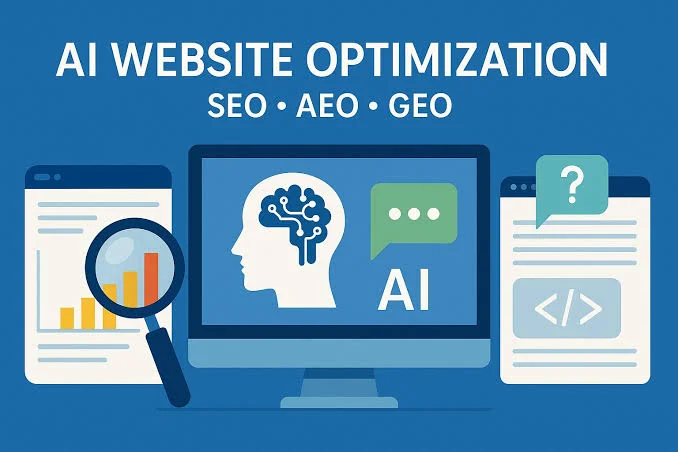
A website must be technically sound before AI strategies can deliver results. AI website optimization can help businesses analyze large websites for structural and technical opportunities.
AI may assist with prioritizing issues based on their potential impact instead of simply presenting a long list of errors. For example, fixing an indexing problem affecting thousands of important pages is more significant than correcting a minor metadata issue on a single low-value page.
How AI Can Improve SEO Content
One of the most visible applications of artificial intelligence in SEO is content creation and optimization. AI can help with:
- Topic ideation
- Search intent analysis
- Content outlines
- Content briefs
- Keyword mapping
- Content gap analysis
- Readability improvements
- Content refreshes
- FAQ and question research
- Semantic optimization
However, simply publishing AI-generated articles at scale is not a sustainable SEO strategy. Search visibility depends on usefulness, relevance, quality, trustworthiness, and the ability to satisfy users.
Benefits of Artificial Intelligence Search Engine Optimization
Businesses can get several advantages from artificial intelligence search engine optimization including:
- Scalability
- Efficiency
- Faster Insights
- Better Personalization
- Continuous Optimization
- Improved Decision-Making
Final Words
AI SEO services combine artificial intelligence with established search engine optimization practices to make research, analysis, content optimization, technical SEO, and performance monitoring more efficient.
However, AI should be viewed as an accelerator rather than a replacement for SEO expertise. The most effective approach has both, accurate data, strong technical foundations, useful content, human judgment, and continuous measurement.
As search continues moving toward AI-powered experiences, businesses that invest in both traditional SEO fundamentals and emerging AI search optimization will be better positioned to maintain visibility in an increasingly competitive digital environment.
Frequently Asked Questions
1. What is the difference between AI SEO and traditional SEO?
Traditional SEO relies on manual research and analysis, while AI SEO uses artificial intelligence to automate and accelerate many of these processes. AI does not replace core SEO principles, it makes many SEO workflows faster and more scalable.
2. Can AI SEO improve website rankings?
AI can help improve the quality and efficiency of SEO work, but no AI SEO service can guarantee rankings. Search visibility depends on factors including content quality, technical SEO, competition, authority, relevance, user experience, and ongoing search-engine changes.
3. What is AI Mode in search?
AI Mode refers to an AI-powered search experience that allows users to interact with search more conversationally and receive direct answers. This creates additional considerations for businesses seeking visibility beyond traditional search results.
4. Can AI-generated content rank on search engines?
AI-generated content can appear in search results, but using AI alone does not guarantee rankings. Content should provide genuine value, demonstrate appropriate expertise, be accurate, and satisfy the user’s search intent.
5. Should businesses hire AI SEO services?
Businesses can benefit from AI SEO services when they need to analyze large amounts of data, scale optimization, improve efficiency, or adapt to AI-powered search. The best services combine AI technology with experienced manual SEO strategy and oversight.